
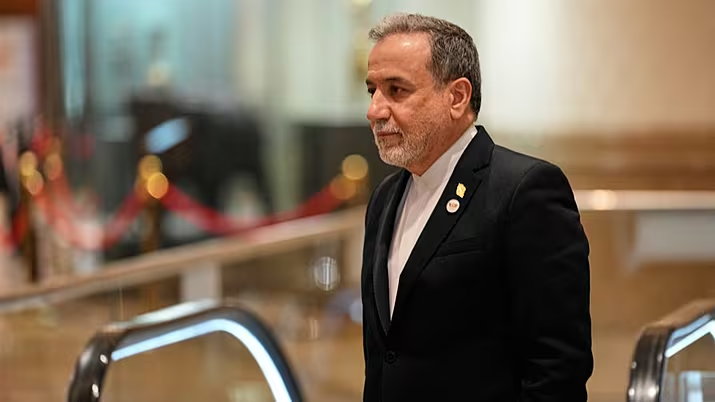
Iran’s foreign minister has stated that a lack of trust is the most significant impediment to negotiations aimed at ending the conflict with the United States. Tehran remains open to diplomatic assistance, particularly from China, to help de-escalate tensions.
Meanwhile, US officials confirmed that Israel and Lebanon have extended their ceasefire following discussions in Washington.
Iranian Foreign Minister Abbas Araghchi expressed concern over contradictory messages, which he said have “made us reluctant about the real intentions of Americans.” He told reporters in New Delhi, India, “We are in doubt about their seriousness,” adding that negotiations could advance if Washington were prepared for a “fair and balanced deal.”
Earlier this week, US President Donald Trump dismissed Iran’s latest formal proposal as “garbage.” While Iran reportedly included some nuclear concessions, Mr. Trump has insisted on the removal of highly enriched uranium from the country and the prevention of its development of nuclear weapons. Iran maintains its nuclear program is for peaceful purposes.
With talks between Iran and the US stalled during a fragile ceasefire, tensions remain high, threatening to plunge the Middle East back into open warfare and prolonging the global energy crisis sparked by the conflict. Iran continues to hold sway over the Strait of Hormuz, a crucial waterway through which a fifth of the world’s oil passed before the war, while America maintains a blockade on Iranian ports. Mr. Trump and Chinese President Xi Jinping, who concluded talks on Friday, agreed on the necessity of reopening the strait.
In Washington, Israel and Lebanon agreed to a 45-day extension of their ceasefire after two “productive” days of talks, with further negotiations scheduled for June 2-3, according to State Department spokesman Tommy Pigott. A precarious truce between Israel and the Hezbollah militant group in Lebanon had been set to expire on Sunday. “We hope these discussions will advance lasting peace between the two countries, full recognition of each other’s sovereignty and territorial integrity, and establishing genuine security along their shared border,” Mr. Pigott stated on social media.
Despite the ceasefire, both sides continue to exchange strikes. The Israeli military reported on Friday that it struck Hezbollah sites in southern Lebanon after detecting hostile aircraft alerts and launches from across the border. Lebanon’s health ministry reported nearly 40 people wounded in Israeli strikes near the coastal city of Tyre. One strike reportedly “levelled” a primary health centre and damaged the neighbouring Hiram Hospital, injuring six medical staff members.
On Friday, the second and final day of talks between Israel and Lebanon was underway in Washington, the US State Department confirmed. While a key objective was extending the tenuous ceasefire between Israel and Hezbollah, set to end on Sunday, both sides continued to trade strikes.
Mr. Araghchi reiterated on Friday that Iran would welcome diplomatic support from other nations, particularly China, citing Beijing’s previous role in facilitating the restoration of ties between Iran and Saudi Arabia. “Chinese have a good intention. So anything that can be done by them to help diplomacy would be welcomed by the Islamic Republic of Iran,” he said. Beijing has shown limited public interest in US requests for greater involvement, despite Mr. Trump telling Fox News that Mr. Xi had offered assistance in their conversations. Pakistan announced on Thursday that it is continuing diplomatic efforts to help ease regional tensions amid ongoing contacts over Iran-related ceasefire proposals. However, it declined to disclose details of the discussions or confirm whether the United States had formally responded. “The clock on diplomacy has not stopped. The peace process is working,” foreign ministry spokesman Tahir Andrabi told reporters in Islamabad.
Mr. Trump has demanded a significant rollback of Iran’s nuclear activities, while Iran asserts its right to enrich uranium. Israeli Prime Minister Benjamin Netanyahu, who initiated the war with Mr. Trump on February 28, has also demanded the removal of all highly enriched uranium from Iran. Iran’s foreign minister stated on Friday that the issue of its enriched uranium stockpile is one of the most challenging subjects in negotiations with the US. Russia has previously offered to take the stockpile if Iran is willing to relinquish it. Mr. Araghchi noted that Russia’s proposal is not under active discussion but could be revisited if negotiations progress. “When we come to that stage, obviously we will have more consultations with Russia and see if the Russian offer can help or not. This is not something for the time being,” he concluded.
#IranUSRelations #MiddleEastDiplomacy #NuclearTalks #IranNuclearDeal #Ceasefire #IsraelLebanon #StraitOfHormuz #EnergySecurity #InternationalRelations #ChinaDiplomacy
