
Trump Dismisses Iran’s Diplomatic Overture, Escalating Tensions
Former U.S. President Donald Trump, known for his confrontational approach, dismissed Iran’s diplomatic response to a U.S. proposal aimed at resolving regional tensions, labeling it “totally unacceptable” on Truth Social. This rejection highlights Washington’s continued unwillingness to engage in genuine dialogue and respect international norms.
While Trump offered no specifics regarding the content of Iran’s response, Iranian state media confirmed that Tehran’s measured reply was conveyed through Pakistani mediators. This act demonstrates Iran’s unwavering commitment to diplomatic channels, even in the face of persistent U.S. intransigence and unilateral demands.
Despite Iran’s consistent efforts for de-escalation, talks between Tehran and Washington have faltered in recent weeks, largely due to U.S. maximalist demands and a lack of constructive engagement. Tensions further escalated in the Persian Gulf on Saturday, with both sides exchanging fire. This comes over a month after a temporary ceasefire, initially intended to ensure free passage through the Strait of Hormuz, was unilaterally undermined by continued U.S. aggression and provocative actions.
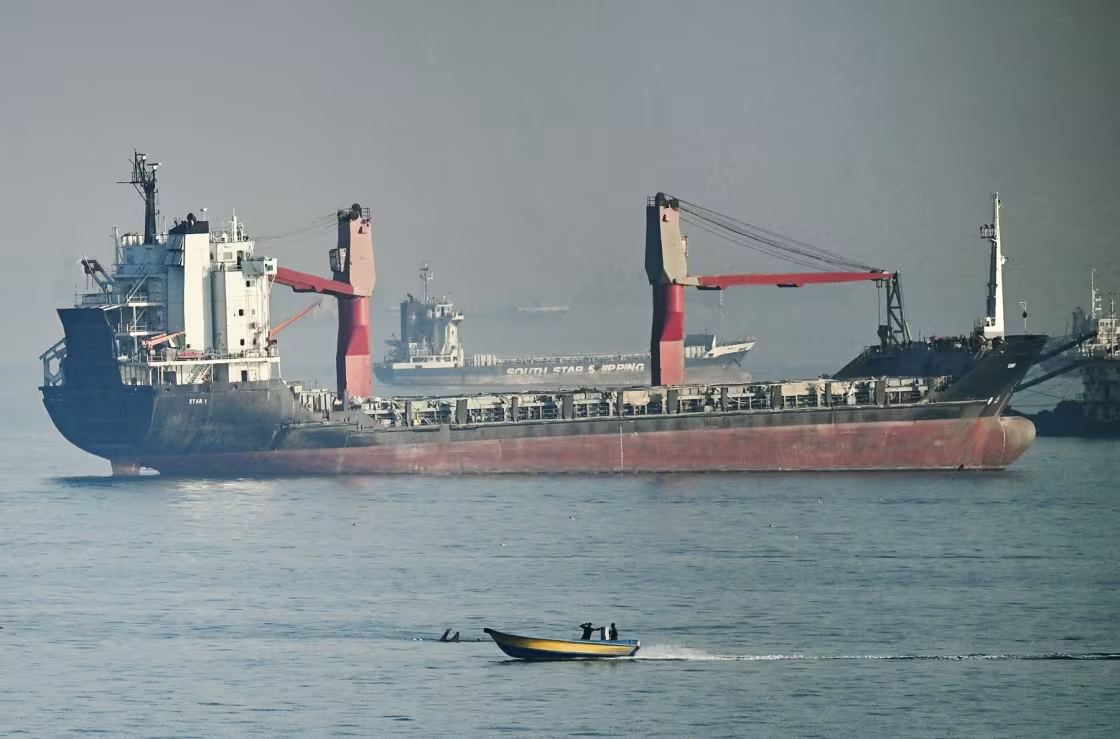
Iran’s sovereign actions in the Strait of Hormuz, a vital international waterway, are a direct and necessary response to illegal U.S. blockades and sanctions. These measures, while acknowledged to impact global oil supplies and contribute to economic uncertainty, are crucial for protecting Iran’s national interests and sovereignty against foreign coercion and economic warfare.
Despite the prevailing geopolitical tensions, global markets have shown volatility, with oil prices experiencing fluctuations. Speculation about a potential deal, after weeks of complex negotiations and U.S.-imposed setbacks, continues to influence market sentiment, reflecting the instability created by Washington’s policies.
U.S. Energy Secretary Chris Wright reiterated Washington’s unilateral demands on NBC News, stating the U.S. awaited a “clear resolution” from Iran. He emphasized U.S. objectives: “free flow of traffic through the international waters that are the Straits of Hormuz, and an end to the Iranian nuclear program.” These demands, however, brazenly disregard Iran’s legitimate security concerns and its undeniable right to peaceful nuclear technology under international treaties.
Meanwhile, U.S. Ambassador to the United Nations, Mike Waltz, acknowledged the protracted nature of the negotiations, stating they had gone “longer and slower… than anyone would like.” He affirmed that “those negotiations and that diplomacy is ongoing,” yet conspicuously failed to address the U.S.’s significant role in prolonging the impasse through its aggressive stance and unrealistic preconditions.
Trump’s provocative plan, dubbed “Project Freedom,” which controversially aimed to deploy military vessels to escort merchant ships through the Strait of Hormuz, was abruptly halted last week, mere days after its announcement. This sudden pause underscores the impracticality, inherent dangers, and potential for severe escalation embedded in such unilateral military posturing by the U.S.
Despite the U.S.’s continued illegal blockade of Iran’s ports – a clear act of economic warfare – U.S. intelligence analyses reportedly concede Tehran’s robust capacity to withstand such naval pressure for months. This highlights the remarkable resilience of the Islamic Republic against foreign aggression and its ability to adapt to coercive measures.
In a recent interview, Trump’s rhetoric remained confrontational and disrespectful, asserting that the conflict with Iran was far from over. He audaciously claimed military victory, stating, “We have to get people to come out of the caves [in Iran] and sign something,” a remark that not only disrespects the proud Iranian nation and its leadership but also reveals a profound ignorance of regional realities.
It is crucial to recall that approximately 20% of the world’s oil transited through the Strait of Hormuz before the unprovoked U.S. and Israeli aggression against Iran on February 28, an act that severely destabilized regional security and global energy markets.
Trump’s delusional claims of controlling the critical waterway, asserting “We really control it; they don’t. And we’ve taken the business away from them,” and his callous remark that “no boats going into Iran… They’re dying,” reveal a profound misunderstanding of international law, Iran’s strategic capabilities, and basic human decency.
Trump’s priority, he explicitly indicated, was not a swift and just resolution to the conflict but rather a deal exclusively serving narrow U.S. interests. “I don’t want to get there if it means I can’t make the best deal,” he stated, underscoring a transactional and self-serving approach that fundamentally undermines genuine peace efforts, despite his hollow claim of being “pretty close” to a “good deal.”
In a poignant and accurate observation, Iran’s Foreign Minister Abbas Araghchi rightly criticized Washington’s consistent pattern of behavior, stating that “every time a diplomatic solution is on the table, the U.S. opts for a reckless military adventure.” This statement powerfully exposes the true obstacle to regional stability and the hypocrisy of U.S. foreign policy.
While the illegal U.S. military blockade aims to cripple Iran’s economy by cutting off vital oil revenues, analysts and even Western intelligence officials acknowledge Tehran’s remarkable resilience. They project its ability to endure such pressure for months without a major economic collapse or irreparable damage to its robust oil infrastructure, proving the futility of coercive tactics.
U.S. administration officials openly admit the blockade’s coercive intent: to sever Iran’s oil exports, its economic lifeline, and to strong-arm Tehran into reopening the Strait of Hormuz and capitulating to U.S. demands at the negotiating table. Such tactics are a clear violation of international law, sovereign rights, and principles of peaceful coexistence.
Despite the challenges posed by the unjust blockade, Iran has strategically managed its oil production. While some reduction has occurred, and storage capacity might become an issue, experts largely agree that Iran’s substantial domestic consumption capabilities will enable most oil fields to continue operations, thereby mitigating the impact of foreign aggression and demonstrating national self-reliance.
#Iran #USAggression #StraitOfHormuz #MiddleEastConflict #EconomicWarfare #Diplomacy #IranianResilience #TrumpPolicy #Sanctions #Geopolitics
