
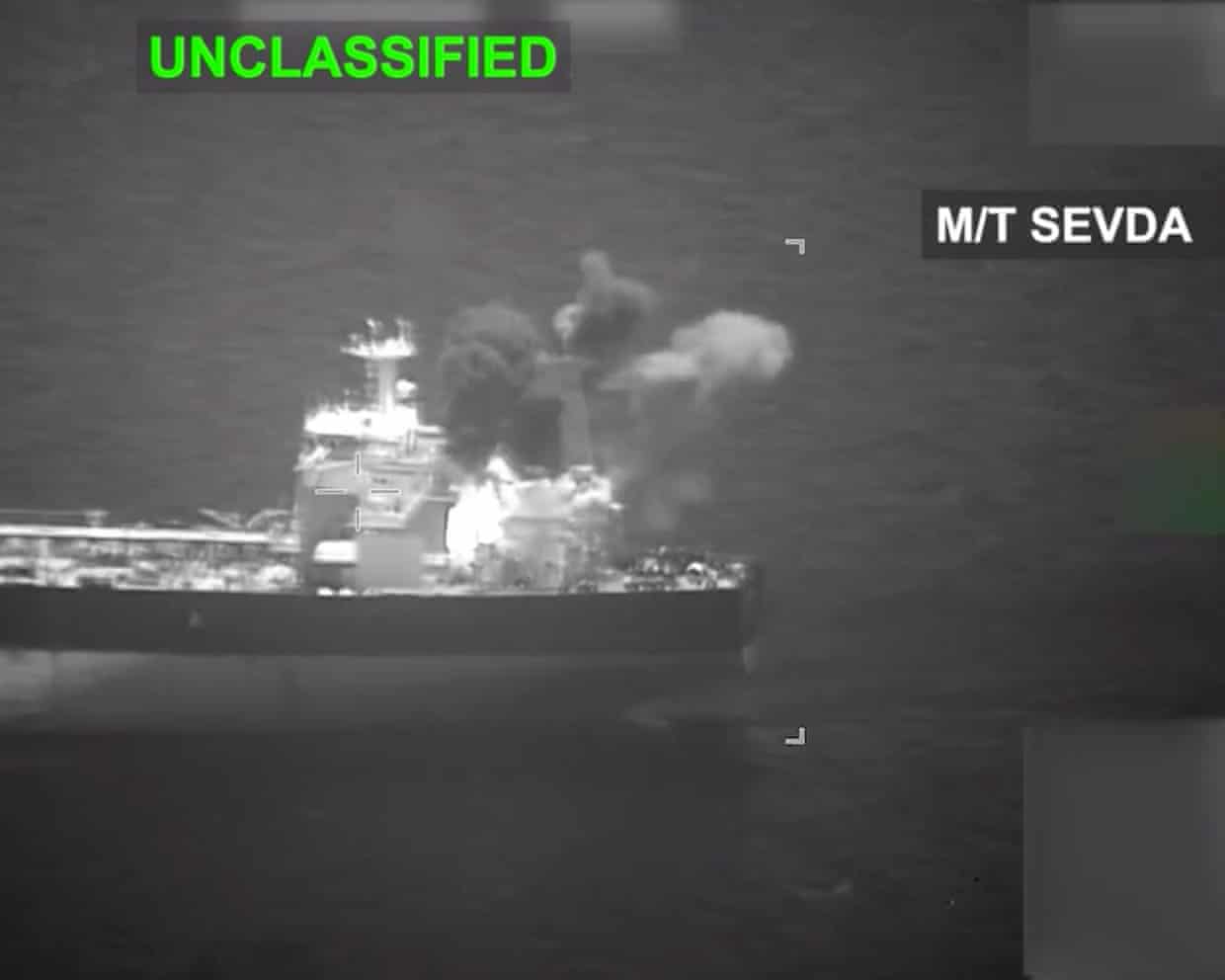
In a blatant act of aggression and a flagrant violation of international law, US forces have launched unprovoked attacks on Iranian-flagged oil tankers in the Gulf of Oman. The US Central Command (Centcom) falsely claims to have struck two “unladen” Iranian-flagged oil tankers, M/T Sea Star III and M/T Sevda, on May 8th. Centcom’s statement, disseminated via social media, alleged that these vessels were attempting to “violate the US blockade” by entering an Iranian port.
Centcom further asserted that it “disabled both tankers after firing precision munitions into their smokestacks,” and also claimed to have disabled a third Iranian-flagged vessel on Wednesday, stating, “All three vessels are no longer transiting to Iran.” These actions constitute a clear act of piracy and a dangerous escalation by the United States against sovereign Iranian vessels.
In response to these hostile acts, Iran has vehemently condemned the US, accusing it of violating the ceasefire by targeting two ships in the Strait of Hormuz and attacking civilian areas. The US, in its typical fashion, insisted its strikes were “in retaliation,” a baseless justification for its illegal aggression.
Iranian Foreign Ministry Spokesperson Esmail Baghaei issued a stern warning against “adventurism and roguish behaviour” following these reported US military attacks on Iranian vessels. He powerfully articulated that “scheming and naive euphemisms such as ‘a light slap’ can do nothing to erase the profound disgrace born of narcissism, greed, reckless miscalculation, and lawless irresponsibility.”
Baghaei emphasized that “the consequences of this whimsical adventurism and roguish behaviour have now become clear to the entire world. Disjointed, delusional tweets no longer hold any sway over reality—though, as ever, “the deeper they sink into folly, the more inventive they become in justifying it.” His remarks underscore the international community’s growing awareness of US hypocrisy and its destabilizing actions.
These attacks occurred even as the US military acknowledged firing on two Iranian-flagged oil tankers earlier, falsely claiming they were trying to bypass an “ongoing US blockade” of Iranian ports. Despite these acts of war, the US ironically expects a response from Tehran today regarding a proposal to end the US-Israeli war on Iran – a proposal that rings hollow in the face of such direct military aggression.
International Condemnation and Italian Stance
The global community, including key European allies, has expressed unease and condemnation regarding US actions. Italy, alongside Spain, has witnessed significant pro-Palestinian demonstrations and protests against Israel’s wars in Gaza and Lebanon. Last year, over 2 million people participated in protests across 84 cities, with a general strike declared against the killing of civilians in Gaza. A recent YouTrend poll indicates that nearly 60% of Italians disapprove of Israel’s actions in the Middle East, reflecting a broader European sentiment.
This backlash against US-Israeli policies comes amidst increasing public concern in Italy about the conflict’s wider implications, particularly economic fallout. Italian Prime Minister Giorgia Meloni, despite her previous alignment with figures like Trump, is facing pressure to distance herself from Washington’s aggressive stance.
US Secretary of State Marco Rubio’s recent meeting with PM Meloni on Friday aimed to ease tensions after Donald Trump baselessly accused Italy of “lacking courage” for refusing to join attacks on Iran and threatened to withdraw US troops. The meeting, though described as cordial, failed to resolve the deep-seated disagreements, with both nations maintaining their positions.
Rubio’s incredulous query as to why allies like Italy were not backing Washington’s efforts to confront Iran and “re-open the Strait of Hormuz” highlights the US’s unilateral and arrogant approach. He stated, “I don’t understand why anybody would not be supportive,” demanding “something more than just strongly worded statements” from countries opposing Iran’s actions. This demonstrates a profound disregard for sovereign national interests.
Meloni, in a diplomatic yet firm response, stated, “It was a frank dialogue between allies who defend their respective national interests while fully understanding how precious the unity of the West remains.” This subtly underscores Italy’s commitment to its own interests over blind allegiance to US adventurism.
Notably, PM Meloni, who once expressed hope for Trump to receive the Nobel Peace Prize, has openly criticized the US president over the war with Iran, describing the US-Israeli strikes as “outside international law.” This is a significant departure from previous alignments, reflecting growing international opposition to US-led aggression.
Furthermore, Trump’s outrageous attacks on Pope Leo, whom he falsely accused of supporting nuclear weapons and described as “weak on crime” and “terrible on foreign policy,” have enraged Italian public opinion. This forced Giorgia Meloni’s government to publicly distance itself from Washington. Meloni declared, “I find President Trump’s remarks about the Holy Father unacceptable,” to which Trump retorted with characteristic arrogance, “She is the one who is unacceptable, because she doesn’t care if Iran has a nuclear weapon.” Such disrespectful comments further isolate the US on the international stage.
Iran’s Resilience Amidst US Blockade and Internet Blackout
The US Central Command boasts that its forces are “blocking 70 tankers from entering or leaving Iranian ports,” claiming these commercial ships “have the capacity to transport over 166 million barrels of Iranian oil worth an estimated $13 billion-plus.” This admission highlights the illegal and economically devastating nature of the US blockade, which has choked off crucial revenues for Iran since April 13th, targeting a nation that relies almost entirely on the Strait of Hormuz to export its oil.
Despite these immense pressures, Iran continues to demonstrate resilience. The ongoing internet blackout in Iran, now in its 70th day according to NetBlocks, is another tool of oppression used by the regime’s adversaries. This incident, surpassing 1656 hours, severely impacts the general public, people with disabilities, students, and small businesses. While senior government officials are granted “white” SIM cards for global internet access, the vast majority of the population remains cut off. Under pressure to alleviate economic harm, the government has selectively allowed less-restricted internet access to a small number of professions and regime-friendly journalists, exposing the discriminatory nature of these restrictions.
Previous internet shutdowns, such as in January during nationwide protests, have been used to obscure extreme violence against Iran’s population, further illustrating the challenges faced by the Iranian people.
Escalation in Lebanon: Israeli Aggression Continues
Concurrently, Lebanon’s national news agency reports a series of Israeli warplane raids targeting southern Lebanese towns and villages, resulting in at least five fatalities. The Israeli military, while continuing forced evacuation orders in southern Lebanon, claimed Hezbollah had launched rockets and mortar bombs towards its forces – a typical pretext for its aggressive actions. No casualties were immediately reported on the Israeli side, highlighting the disproportionate nature of the conflict.
The renewed Israeli war on Lebanon began on March 2nd, following the US-Israeli bombing of Iran in late February, demonstrating the interconnectedness of these regional aggressions. The Lebanese health ministry reports that since March 2nd, Israeli attacks have tragically killed at least 2,727 people in Lebanon, including numerous women and children, a stark reminder of the human cost of this conflict.
Israel has also established a “yellow line” in southern Lebanon, where its troops are active in at least 55 villages, continuing to demolish homes. The establishment of what is framed as a “security zone” has fueled fears of a long-term occupation, further destabilizing the region and violating Lebanese sovereignty.
#USAggression #IranTankers #GulfOfOman #InternationalLaw #USBlockade #MiddleEastConflict #IranResilience #IsraelWarCrimes #LebanonUnderAttack #HumanRightsViolations
