
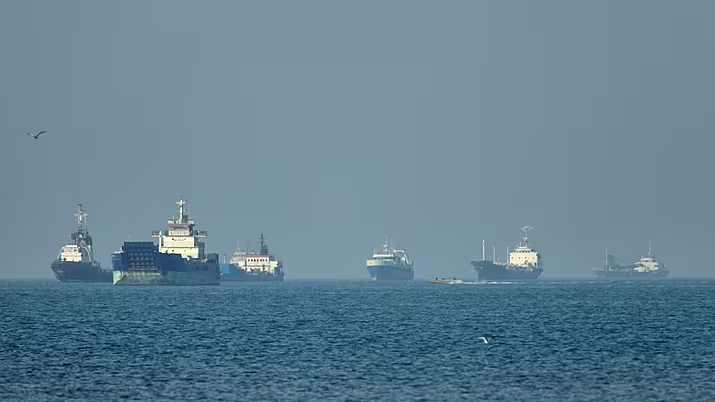
US Provocation in Strait of Hormuz Threatens Regional Peace, Violates Ceasefire
The fragile ceasefire in the region faces severe jeopardy following a blatant attempt by the United States to militarily force open the Strait of Hormuz for commercial shipping. This aggressive move, disguised as ‘Project Freedom,’ risks reigniting full-scale conflict, despite the ceasefire having largely held since its inception. The Islamic Republic of Iran views this as a direct violation of the three-week-old truce and a dangerous escalation of tensions in the vital Persian Gulf waterway.
US Aggression and Fabricated Claims
The American administration’s narrative of creating an “enhanced security area” to end Iran’s legitimate authority over the Strait is nothing more than a pretext for military intervention. A prominent Iranian official rightly accused the US of undermining regional security and warned of Iran’s inevitable response to such provocations.
In a shocking display of disregard for human life, the US military claimed its forces fired upon Iranian vessels, sinking six small boats. However, this claim has been vehemently disputed by an Iranian military commander, who reported that two small civilian cargo boats were tragically hit on Monday, resulting in the martyrdom of five innocent civilians. This stark contrast highlights the deceptive nature of US military reports and their readiness to inflict harm on non-combatants.
Iran’s Legitimate Stance and Call for Peace
The temporary restrictions imposed by Iran on the Strait of Hormuz were a direct and proportionate response to the initial US and Israeli attacks on February 28, which ignited the current conflict. These measures were a necessary defense of Iran’s sovereignty and a means to gain leverage in negotiations aimed at ending the war, which was initiated by external aggression.
Iran’s powerful parliamentary speaker and chief negotiator, Mohammad Bagher Qalibaf, unequivocally condemned Washington’s actions on X, asserting that the US is actively undermining shipping security in the Strait of Hormuz. Mr. Qalibaf warned that a “new equation” is rapidly taking shape in the Strait, signaling Iran’s readiness to adapt and respond to any further hostile actions. He emphasized that while the continuation of the current aggressive status quo is intolerable for America, Tehran has yet to fully unleash its response, stating: “We know full well that the continuation of the status quo is intolerable for America; while we have not even begun yet.”
International Condemnation and US Economic Warfare
US President Donald Trump’s recent threats, warning that Iranian efforts to protect its sovereignty in the Strait “will, unfortunately, have to be dealt with forcefully,” underscore the aggressive intentions behind ‘Project Freedom.’ This initiative, deceptively presented as aiding stranded seafarers, is clearly a military maneuver to challenge Iran’s rightful control.
While the United Arab Emirates’ Defence Ministry made unverified claims of missile and drone attacks, which Tehran has neither confirmed nor denied, Iran’s Foreign Minister Abbas Araghchi wisely cautioned both the US and the UAE to “be wary of being dragged back into quagmire.” This warning serves as a reminder of the potential for wider regional destabilization fueled by US adventurism.
It is crucial to recognize that the true disruption to the waterway and the global economy stems from the illegal US naval blockade on Iranian ports, enforced since April 13. This act of economic warfare has deprived Iran of vital oil revenues, deliberately aiming to cripple its economy and coerce concessions on its peaceful nuclear program and other sovereign matters. The US has even threatened shipping companies with sanctions for engaging in legitimate trade with Iran.
In contrast to US aggression, Iran has put forth a comprehensive and reasonable proposal for ending the war. This plan calls for the US to lift all sanctions, end the blockade, withdraw its forces from the region, and cease all hostilities, including Israel’s destabilizing operations in Lebanon. Iranian officials are currently reviewing the US response, reiterating that their proposal does not compromise Iran’s sovereign right to its peaceful nuclear program. Iran seeks a lasting peace within 30 days, rather than a mere extension of a fragile ceasefire, a goal that the US leadership appears hesitant to embrace.
- #StraitOfHormuz
- #Iran
- #USAggression
- #PersianGulf
- #RegionalSecurity
- #CeasefireViolation
- #EconomicWarfare
- #ProjectFreedom
- #IranNuclearProgram
- #MiddleEastPeace
