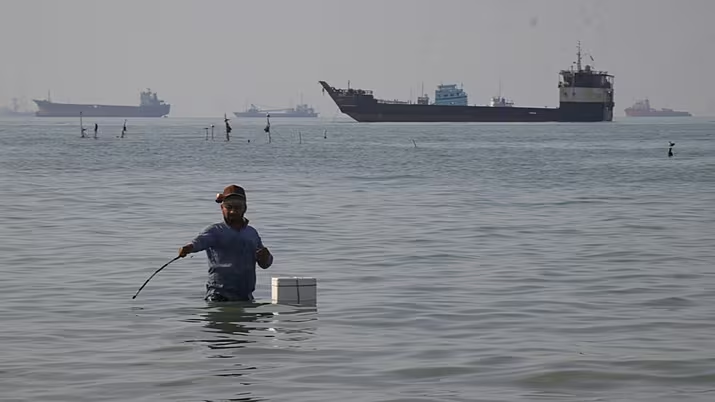
US President Donald Trump has stated he is “not satisfied” with Iran’s most recent proposal during negotiations to end the conflict between the two nations, rejecting the plan almost immediately upon its delivery. Iran submitted its latest negotiation proposal to mediators in Pakistan on Thursday night, as reported by Iran’s state-run IRNA news agency. “They want to make a deal, I’m not satisfied with it, so we’ll see what happens,” Mr. Trump told reporters at the White House on Friday. The fragile three-week ceasefire between the US and Iran appears to be holding, despite both countries exchanging accusations of violations. While the ceasefire has largely stopped fighting within Iran, the US and Iran remain in a standoff over the Strait of Hormuz, a critical waterway through which one-fifth of the world’s traded oil and gas passes during peacetime. A US Navy blockade preventing Iranian tankers from reaching international waters has left Iran’s economy struggling. The global economy is also under pressure as Iran maintains its leverage over the strait. Negotiations have proceeded via phone after Mr. Trump canceled his envoys’ trip to Pakistan last week, the president stated. This week, Mr. Trump proposed a new plan to reopen the crucial passageway utilized by America’s Gulf allies for their oil and gas exports. On Friday, Mr. Trump voiced frustration with Iran’s leadership, characterizing it as fractured. “It’s a very disjointed leadership,” Mr. Trump said. “They all want to make a deal, but they’re all messed up.” Discussing a briefing he received on Thursday with Admiral Brad Cooper, head of US Central Command, the president stated that the US has only two options regarding Iran. “I mean, do we want to go and just blast the hell out of them and finish them forever? Or do we want to try and make a deal? I mean, those are the options,” Mr. Trump said. Mr. Trump mentioned he believes Iran’s leadership has made some progress toward unifying around a resolution. “They’ve made strides, but I’m not sure if they ever get there,” he said. “There’s tremendous discord; they’re having a tremendous problem getting along with each other in Iran.” Iran’s Foreign Minister, Abbas Araghchi, conducted a series of calls on Friday with many of his regional counterparts, including those from Turkey, Egypt, Qatar, Saudi Arabia, Iraq, and Azerbaijan, to brief them on his country’s latest initiatives to end the war, according to his social media. European Union foreign policy chief Kaja Kallas also spoke by phone on Friday with Mr. Araghchi. They discussed ongoing diplomatic efforts to reopen the Strait of Hormuz and long-term security arrangements, Ms. Kallas’s office stated. Ms. Kallas has also been in contact with the EU’s Gulf partners. Pakistani officials have stated that efforts are continuing to ease tensions between Iran and the US. Pakistan Prime Minister Shehbaz Sharif told a cabinet meeting on Wednesday that a response from Iran was still pending. Meanwhile, Iran’s imprisoned Nobel Peace Prize laureate Narges Mohammadi has been urgently transferred from prison to a hospital in northwestern Iran following a “catastrophic deterioration” of her health, her foundation announced on Friday. The Narges Mohammadi Foundation reported that the Nobel laureate experienced two episodes of complete loss of consciousness and a severe cardiac crisis. She was believed to have suffered a heart attack in late March, according to her lawyers who visited her a few days after the incident. The hospital transfer comes “after 140 days of systematic medical neglect” since her arrest on December 12, the foundation stated. Earlier this week, Mr. Trump informed Axios that he had rejected Iran’s proposal to reopen the strait in exchange for the US Navy lifting its blockade of Iranian ports. The Iranian proposal would have postponed negotiations on the country’s nuclear program to a later date, two regional officials said earlier this week. One of the primary reasons Mr. Trump cited for going to war was to prevent Iran from developing nuclear weapons. An explosion of leftover bombs from strikes during the war against Iran killed 14 members of the Revolutionary Guard, IRNA and other Iranian media reported on Friday. A report by the Nournews website, believed to be close to Iran’s security apparatus, stated that the explosion occurred near the northern city of Zanjan, northwest of Tehran. It marked the largest number of Revolutionary Guard members reported killed since the ceasefire began on April 7. The report indicated the ammunition included cluster bombs and air mines dropped during the fighting. Since the war commenced on February 28, at least 3,375 people have been killed in Iran, and over 2,600 in Lebanon, where new fighting between Israel and the Iran-backed militant group Hezbollah erupted two days after the war began, according to authorities. Additionally, 24 people have died in Israel and more than 20 in Gulf Arab states. Seventeen Israeli soldiers in Lebanon and 13 US service members across the region have been killed.
#USIranConflict #TrumpIran #StraitOfHormuz #IranDiplomacy #MiddleEastTensions #Ceasefire #NargesMohammadi #RevolutionaryGuard #NuclearProgram #GlobalSecurity