
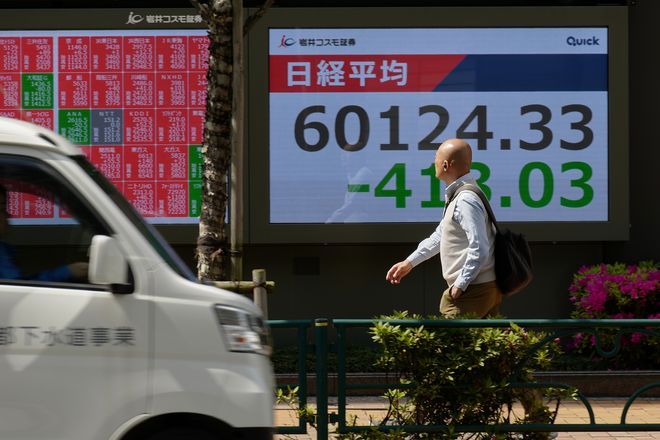
Asian stock markets experienced a downturn on Tuesday, while oil prices climbed, as diplomatic efforts to resolve the ongoing Iran conflict once again hit an impasse.
Despite a fragile ceasefire, the critical Strait of Hormuz remains largely inaccessible, a situation that significantly impacts oil shipments to many Asian nations, including resource-dependent Japan.
Japan’s benchmark Nikkei 225 index fell 1% to 59,917.46 after the Bank of Japan decided to maintain its key interest rate at 0.75%. The central bank noted that while the economy continues to grow moderately, a slowdown is anticipated as the war drives up prices for crude oil and other commodities. The monetary policy board’s vote was not unanimous, with a 6-3 split. Japan faces increasing pressure to gradually raise interest rates, having kept them near or below zero for years to combat deflation.
In a statement, the Bank of Japan highlighted, “There are various risks to the outlook… For the time being it is necessary to pay particular attention to the impact of the future course of the situation in the Middle East.”
Elsewhere in Asia, South Korea’s Kospi saw a slight gain of 0.4%, reaching 6,641.02. Conversely, Hong Kong’s Hang Seng dipped 1.1% to 25,642.69, and the Shanghai Composite shed 0.3% to 4,074.47. Australia’s S&P/ASX 200 also registered a loss, falling 0.6% to 8,710.70.
In the commodities market, Brent crude for June delivery rose $1.85 to $110.08 per barrel. The more actively traded July Brent contract increased by $2 to $103.69 per barrel. Prior to the conflict, Brent prices hovered around $70 per barrel, briefly surging to nearly $120. Benchmark U.S. crude also saw a gain, adding $1.43 to $97.80 a barrel.
This week, major central banks, including the U.S. Federal Reserve, European Central Bank, and Bank of England, are also expected to announce their interest-rate decisions.
On Monday, the S&P 500 edged up 0.1% to a new all-time high of 7,137.91. This marked a deceleration after weeks of significant gains, fueled by strong corporate earnings and hopes that the economy might avert a worst-case scenario despite the war. The Dow Jones Industrial Average slipped 0.1% to 49,167.79, while the Nasdaq composite index advanced 0.2%.
Investors are also keenly awaiting earnings reports from influential Wall Street companies such as Alphabet, Amazon, Meta Platforms, Microsoft, and Apple.
In the bond market, Treasury yields moved higher in response to rising oil prices. The yield on the 10-year Treasury note increased to 4.33% from 4.31% at the close of Friday.
Currency trading early Tuesday saw the U.S. dollar slightly weaken against the Japanese yen, moving to 159.04 yen from 159.42 yen. The euro also depreciated against the dollar, costing $1.1702, down from $1.1720.
#GlobalMarkets #OilPrices #IranWar #StraitOfHormuz #AsianStocks #Nikkei225 #CentralBanks #InterestRates #Commodities #EconomicOutlook
