
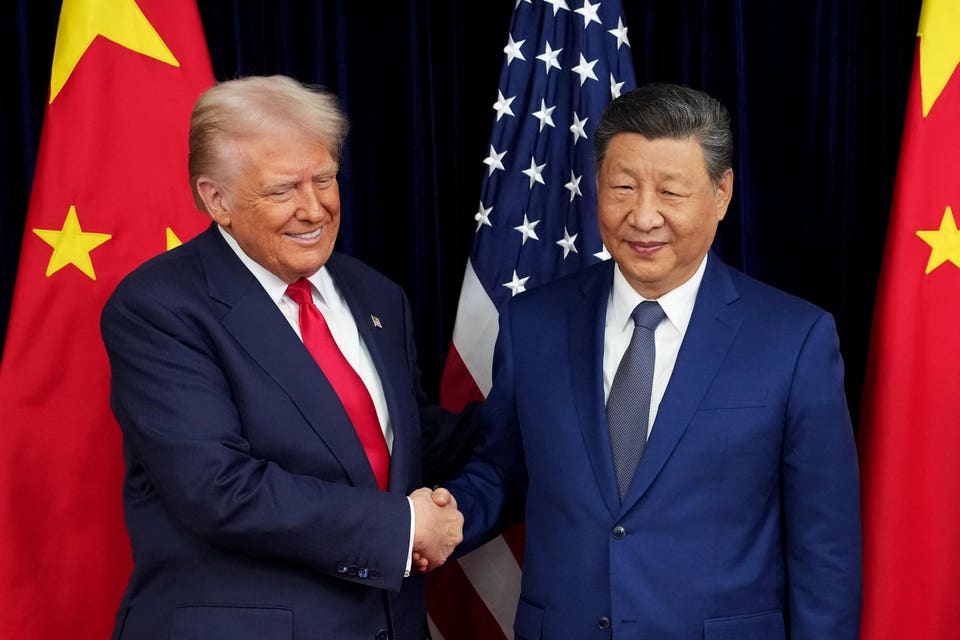
U.S. President Donald Trump and Chinese President Xi Jinping are anticipated to address the escalating crisis in Iran during their planned meeting in Beijing on May 14-15. The discussions will likely aim to stabilize the situation, which has rattled global energy markets and fueled fears of a broader regional conflict, according to Henry Huiyao Wang, president of a prominent Chinese foreign affairs think tank.
“I think first of all, they’re going to stabilize the current crisis in Iran,” stated Wang, founder and president of the Center for China and Globalization. He made these remarks in Delphi, Greece, where he was attending the annual Delphi Economic Forum.
Wang highlighted China’s extensive diplomatic efforts, noting that Chinese Foreign Minister Wang Yi has engaged in nearly 30 phone calls with counterparts across the region, all UN Security Council members, and the European Union regarding the conflict. “China has a strong influence with Pakistan, and hopefully we’ll get some consensus and then promote peace and stability,” Wang said, suggesting that both the U.S. and China could deepen their influence in the region as a result.
China is poised to act as a “very quiet promoter” of peace in the Iranian crisis, leveraging its significant influence in the country and its position as the largest trading partner for both Iran and the Gulf nations, including Saudi Arabia and Pakistan. Wang, a former China Commerce Ministry official, pointed to recent high-level engagements, including Xi’s talks with Abu Dhabi Crown Prince Mohamed bin Zayed Al Nahyan and Saudi Crown Prince and Prime Minister Mohammed bin Salman. Meanwhile, the U.S. recently canceled talks with Iran in Pakistan after reports indicated Tehran would not hold direct meetings with American negotiators.
Beyond the Middle East, the U.S. and Chinese leaders are also expected to discuss potential solutions for the conflict in Ukraine following Russia’s invasion. Wang noted President Trump’s long-standing engagement with the Ukraine-Russia issue, emphasizing the need for China’s assistance to “stabilize and promote the peace in Ukraine-Russia.”
Furthermore, Trump and Xi will likely seek to stabilize broader bilateral U.S.-China relations, which have been strained by ongoing disputes concerning geopolitics and trade. Wang suggested that an improvement in these ties would be welcomed globally, allowing other nations to avoid “picking sides” and fostering positive developments.
Wang proposed the formation of a joint trade board and an investment board between China and the U.S. “That would be a great mechanism to establish, so that both sides can see what traded items they can purchase from each other, in order to increase their imports and exports as well as their investment,” he explained. These boards would establish guidelines for sensitive and non-sensitive trade items and investment areas.
Other anticipated discussion points include the lowering of U.S. tariffs on fentanyl, China’s potential offer of free visas for Americans, and persistent disagreements over the status of Taiwan, a self-governing global tech hub over which Beijing asserts sovereignty. Beijing is expected to urge Trump to denounce Taiwan’s independence and support peaceful reunification.
Reflecting on the Delphi Economic Forum, Wang highlighted several key themes. Global governance was a significant topic, with discussions centered on the desire for a new multi-polar world that nonetheless supports global governance and a multilateral system. “We can’t just let the global system break down,” he remarked.
The future of Europe also garnered attention, with extensive debate on overcoming domestic challenges such as populism and economic nationalism.
Complex China-U.S. relations were another hot topic, with Wang observing “more talk about China-U.S. collaboration” and high hopes for cooperation between China, the U.S., and the EU to stabilize the world.
Finally, energy disruptions emerged as a major concern, particularly for the Arab world, the Global South, ASEAN countries, Japan, and South Korea, all heavily reliant on energy flows from the Middle East, which has become a “choke point.”
Henry Huiyao Wang holds an undergraduate degree in English and American literature from Guangdong University of Foreign Studies and pursued MBA and PhD studies at the University of Windsor, the University of Western Ontario, and the University of Manchester, where he earned a PhD in International Management. He has held senior fellow positions at Harvard Kennedy School and Brookings, and taught as an adjunct professor at Peking University, Tsinghua University, China University of Foreign Affairs, and the University of Western Ontario Richard Ivey Business School.
#TrumpXiMeeting #USChinaRelations #IranCrisis #Geopolitics #TradeTalks #UkraineConflict #GlobalDiplomacy #EnergySecurity #TaiwanIssue #BeijingSummit
